
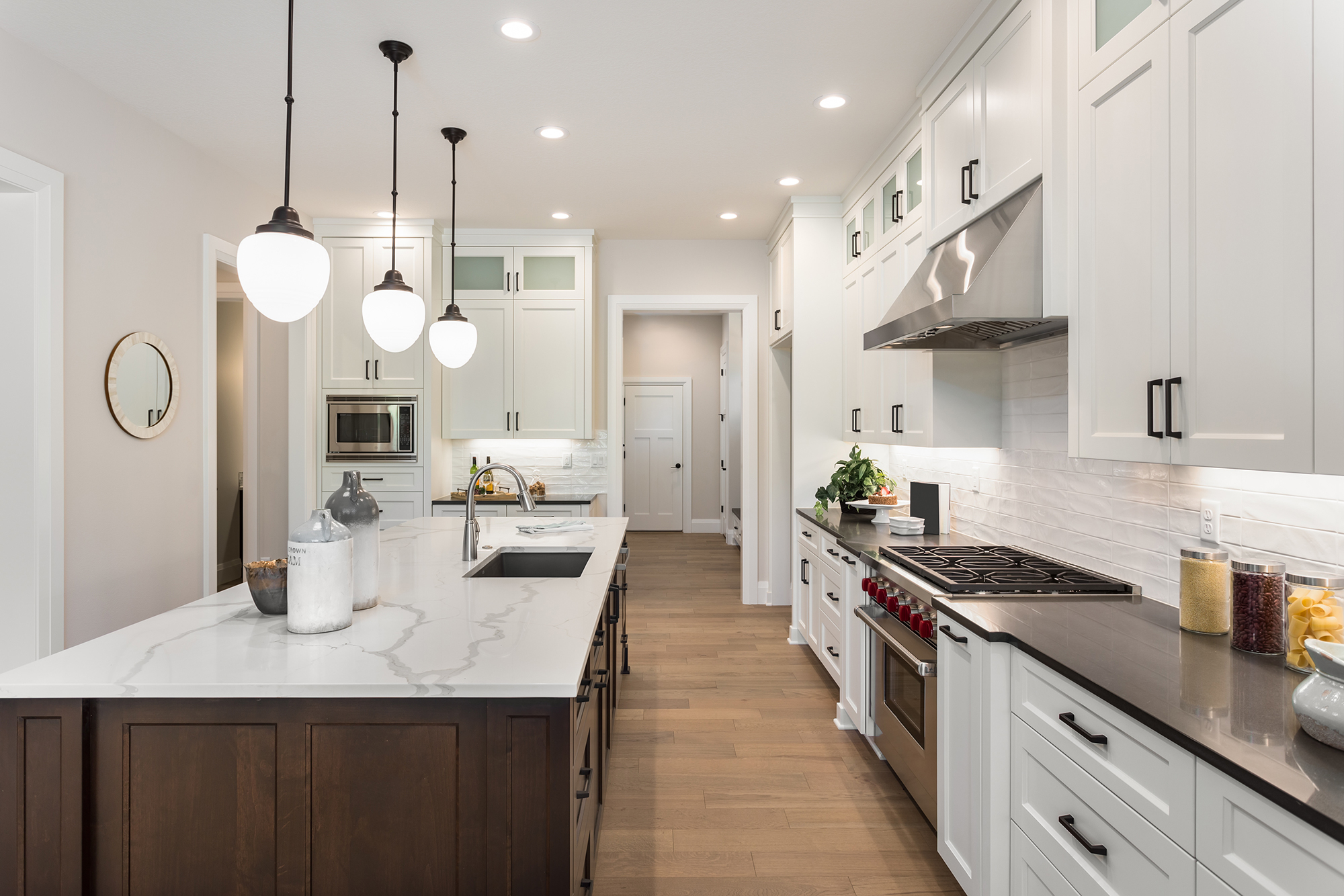
Late at night, your brain wants predictable, low-contrast, warm cues. Kitchens often do the opposite: a few intense downlights, shiny surfaces, and a cool LED spectrum bouncing everywhere. The result can feel oddly stressful, even when the room isn’t objectively “that bright.”
Three technical reasons this happens:
Glare and high luminance: small bright sources (recessed downlights, exposed LED dots) create discomfort.
Contrast: a bright counter under a dark ceiling feels harsh; your eyes constantly adapt.
Spectrum/CCT: cooler light can feel more alerting, especially at night.
The goal: low lux, but visually “safe” and functional
“Low-lux” doesn’t mean “can’t see.” It means:
Enough light for navigation and small tasks
Minimal glare
Soft vertical illumination so the room doesn’t feel like a cave
A practical target range for an evening kitchen scene:
Ambient/navigation: roughly 30–80 lux
Task zones (optional boost on demand): 150–300 lux at the counter, but only where needed
Avoid: blasting the entire kitchen to daytime levels when you’re just resetting the room
(Your exact numbers depend on finishes, ceiling height, and fixture optics.)
Build the low-lux scene using layers
A calm evening kitchen is usually 3–5 circuits working together, not one switch fighting physics:
Toe-kick or floor-level guidance lighting
This is the secret weapon. Low placement reduces glare and gives your eyes a gentle anchor.
Use warm CCT (often 2700K)
Keep output modest and diffuse
Add motion sensors if desired, but avoid aggressive “instant full bright” triggers
Under-cabinet lighting (diffused) for controlled task light
Under-cabinet strips are great at night if they’re:
In aluminum channels
Behind a diffuser
Dimmable smoothly without flicker or stepping
This gives you localized task light without lighting the entire room like a stadium.
Soft vertical light (the room-feel upgrade)
Vertical illumination (on walls, backsplash, or upper cabinets) reduces contrast and makes the space feel calm even at lower lux. Options:
Wall washers
Uplighting on top of cabinets
A gentle pendant with a shade that hides the source
This is how you avoid the “dark-but-stabby” look where one downlight feels like an interrogation lamp.
Overhead downlights: use sparingly in the night scene
If you include them in the evening scene, keep them:
Warm (or warm-dim)
Low output
With good cutoff optics to reduce glare
Spectrum choices: why warmer isn’t just “vibe”
Night lighting should usually shift warmer because it’s psychologically soothing and reduces that “clinical” feel. A smart approach:
Daytime scene: 3000K (common sweet spot in kitchens)
Evening scene: 2700K or warm-dim behavior that slides warmer as it dims
But warmth alone won’t fix glare. A warm light that’s too bright and too point-source still feels harsh.
Fix the “my kitchen looks dark when I dim” problem
This is usually a distribution problem, not a brightness problem. If you dim only overheads, you create:
Dark upper walls
Bright hotspots on counters
Harsh shadows
To fix it:
Add low-level guidance + under-cabinet diffuse light
Add at least one vertical light component
Reduce reflective glare by choosing diffusers and optics carefully
Consider matte finishes where practical (high-gloss reflects point sources brutally)
A practical “Evening Scene” recipe
If you want a starting blueprint:
Toe-kick: ON at low level
Under-cabinet: ON at 10–30% (flicker-free driver matters)
Wall/upper-cabinet uplight: ON low
Overheads: OFF or very low
Optional: one “boost” button for 5 minutes of brighter task light when needed
This creates a kitchen that feels calm, navigable, and still functional. Like a room that’s exhaling instead of shouting.
A low-lux kitchen scene should feel like comfort, not compromise. When you layer low-level guidance, diffuse task lighting, and soft vertical illumination, you can keep nighttime light gentle without making the kitchen feel dim or unsafe. Done right, the room looks better, feels calmer, and supports wind-down instead of fighting it.
Service areas: Holden, Bangor, Ellsworth, Lincoln, Newport, and Camden, Maine.
If you want help designing an evening lighting scene that looks beautiful and feels genuinely restful, visit us or contact The Kitchen People in Holden, ME. We’ll help you select the right fixture types, dimming controls, and placement so your kitchen works for real life, including the late-night reset.


